
Jaishankar said all members would agree that India's approach should be guided by its national beliefs and values, national interest and by its national strategy.

Despite admitting to price pressures both from food items and input prices, RBI Governor Shaktikanta Das on Wednesday hoped that a normal Southwest monsoon will have a "soothing impact" on inflation pressures and ruled out any wide variations in medium-term inflation forecast from what was given in April. In an unscheduled address earlier in the day amidst the raging pandemic, Das said the overall outlook for the economy is highly uncertain and is clouded with downside risks. He offered a slew of relief and liquidity measures to individuals and small businesses apart from a Rs 50,000 crore special liquidity window to the healthcare sector.
Asserting that retail inflation excluding food and fuel is still at an elevated level, the Reserve Bank of India on Tuesday said it would endeavour to curb price increases.

Representing India at the 'High-Level Segment for Heads of States and Government' at the UN COP26 underway at Glasgow, UK, Prime Minister Modi said that India is working very hard on tackling climate change related issues.
Introduced in 2015 under the Foreign Trade Policy, the mega MEIS was created out of a merger of five existing reward schemes.
RBI retained the GDP growth for the financial year 2018-19 at 7.4 per cent.
The earlier high was in January this year at 5.07 per cent.

Two-wheeler sales, however, declined 21.4 per cent to 14,13,378 units last month, as compared to 17,98,201 units in November 2019. Commercial vehicle sales also slipped 31.22 per cent to 50,113 units, as against 72,863 units a year ago. Similarly, three-wheeler sales fell 64.98 per cent to 24,185 units last month, from 69,056 units in the year-ago period. Tractor sales, however, grew by 8.47 per cent to 49,313 units last month, against 45,462 units in the same month last year.

CPI-based inflation on a (year-on-year) basis has come down from 8.59 per cent in April 2014 to 7.80 per cent in August 2014.

There is no direct impact of the Russia-Ukraine crisis on India in terms of bilateral trade but a surge in oil prices poses considerable risk to the economy, an analyst report said on Friday. International oil prices which have surged past $100 per barrel "pose risks to external stability and currency movement," a Bank of Baroda Economics Research report said. Russia has launched military operations against Ukraine, stoking fears of significant disruption in the region, including loss of life. The West is ramping up financial sanctions against Russia and support for Ukraine.
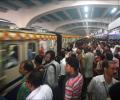
The last revision was done in June wherein passenger fares were revised by 4.2 per cent and freight rates by 1.4 per cent.
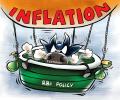
With pricing power of producers unlikely to strengthen and commodities ex-crude oil likely to remain sluggish in the immediate term, the core-WPI inflation may remain sub-zero in the rest of this calendar year.

The six-member monetary policy committee voted 5:1 for the decision, with only Ravindra Dholakia voting for a 0.25 per cent reduction in rates.
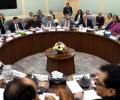
India's likely medium-term potential growth will almost certainly be markedly lower than that experienced in pre-pandemic years, warns Shankar Acharya, former chief economic advisor to the Government of India.

The Reserve Bank of India, for the second straight time, on Thursday kept its key policy rate unchanged at 5.15 per cent, maintaining its accommodative policy stance as long as it was necessary to revive growth. The central bank retained GDP growth at 5 per cent for 2019-20 and pegged it at 6 per cent for the next fiscal.

Monetary policy easing, coupled with the relaxation of lending rules and greater election-driven fiscal spending in the first quarter of 2019, will provide some support to growth during the first half of 2019-20 fiscal
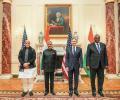
The pressure on India to take a hostile attitude towards Russia and China was not subtle, but it was guarded, observes Ambassador T P Sreenivasan after Monday's 2+2 ministerial meeting in Washington, DC.
Currently, the retail inflation is well below the RBI's comfort level. The government has asked the central bank to keep inflation in the range of 4 per cent.

Silverline seems symptomatic of how Kerala -- its claimed education, awareness and all -- overlooks its real problems, notes Shyam G Menon.

'The levy proposed to be charged on air tickets for regional connectivity fund would marginally increase cost.'

'Earlier, when they were selling tickets at Rs 1,000, a family of five could travel by flight.' 'When it comes to realistic pricing and the price becomes Rs 5,000, a family of five will have shell out Rs 25,000.' 'How many will be able to afford that?' 'You will see people switching back to train travel which is more realistic.'

The Centre on Monday earmarked a separate Rs 2,217 crore for 42 urban centres to tackle air pollution and announced the much-awaited voluntary vehicle scrapping policy to phase out old and polluting vehicles, even as it shrunk the budgetary allocation for the environment ministry from the last fiscal by nearly eight percent. Union Finance Minister Nirmala Sitharaman, in her budget speech for 2021-22, announced a total of Rs 2869.93 crore for the ministry, Rs 230 crore less than the last fiscal. Officials said the outlay has been lesser this time as the economy is recovering from the COVID-19 pandemic.

Darul Uloom Haqqania madrassa, one of Pakistan's largest and oldest seminaries and dubbed as a 'university of jihad' by its critics for helping sow violence across the region for decades, has educated more Taliban leaders than any school in the world and its alumni now hold key positions in Afghanistan, according to a media report.
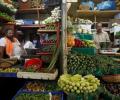
Crisil Research expects retail inflation to rise 60 basis points to 4 per cent this fiscal from 3.4 per cent in 2018-19.
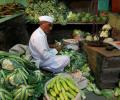
Inflation in onion continued to rule high at 42.22 per cent and in potato at 43.25 per cent.
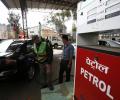
The discount will be by way of cash back which will be credited to the buyer's account in three days from the transaction

The protests brought home the fact that the Sri Lankan public is in no mood for halfway measures, as voices against Rajapaksa 'family rule' and 'securitisation' of the civilian administration began sidestepping the more critical economic crisis, affecting the nation and afflicting the individual, observes Sri Lanka watcher N Sathiya Moorthy.
